
What you do in the first two days after a crash in Florida decides most of what happens in the two years after it. The law has three clocks running from the moment of impact, the insurers have adjusters at work the same day, and the evidence that proves fault starts disappearing almost at once. This is the order of operations, from a firm that has handled these claims across Tampa Bay since 2008.
At the scene
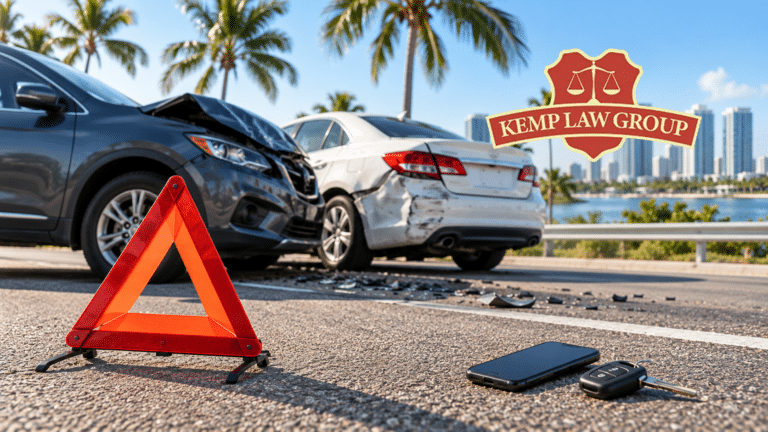
Call 911 and ask for police and medical help, even if everyone says they’re fine. Florida requires a report for any crash with injury or at least $500 in damage, and the crash report is the document every insurer starts from. Stay at the scene until officers release you; leaving the scene of a crash with injury is a crime. Photograph everything before the cars move: all four corners of every vehicle, the plates, the road, the skid marks, the signals and signs, the weather, and your own visible injuries. Get the other driver’s license, registration and insurance card on camera, and the names and phone numbers of witnesses, who will not be on the police report unless the officer takes them. Say nothing about fault to anyone, including “I’m sorry”; the same words become the defense’s first exhibit. If you are hurt and the paramedics offer transport, take it.
The same day
See a doctor. Florida’s no-fault law requires treatment within 14 days of the crash for your own PIP coverage to pay the first $10,000 of medical bills and lost wages; miss it and PIP can refuse to pay. Our post on the 14-day rule covers the exceptions. An emergency room, an urgent care center or your own doctor all count. Tell the provider every symptom, including the ones that seem minor, because the gap between the crash and the first complaint about a neck or back is the insurer’s favorite argument that the injury came from somewhere else. Report the crash to your own insurer, which your policy requires; keep it factual and short. Write down everything you remember while it’s fresh: the time, the roads, the lanes, the speeds, what the other driver said, the weather and the light.
The first 48 hours
Three things, in this order. First, preserve the evidence that is about to disappear: ask every business near the crash site to save its camera footage (most overwrite within days), ask the agency that responded whether body-camera or dash-camera footage exists, and keep your own vehicle unrepaired and un-sold until it is photographed and, if the crash was serious, until its event data recorder has been read. Second, do not give the other driver’s insurer a recorded statement; you have no duty to, and adjusters use them to build comparative fault under Florida’s 51 percent rule. Third, stay off social media about the crash and your injuries, because the adjuster will read it.
The first week
Request the crash report through the state’s portal, and read it: officer narratives contain errors, and the time to correct one is early. Open your PIP claim and, if the other driver was uninsured or underinsured, your own uninsured motorist claim. Keep every receipt and every record of missed work. Do not accept an early offer; the first offer in a Florida injury case arrives before the injury is understood, and it is a fraction of what the claim is worth once the medical picture is complete. And talk to a lawyer: the evidence timeline above is why, since a lawyer’s first job in a crash case is a set of preservation letters sent in days.
The three clocks
Fourteen days to get treatment, for PIP. Two years to file a lawsuit against the at-fault driver, under the 2023 law, with no extension for being in treatment or in negotiations; our post on the two-year deadline explains it. And for a crash involving a government vehicle or road, a written notice requirement under section 768.28 that comes before any lawsuit. The first two are fixed; the third is the one people miss.
What a lawyer does in the first week
Sends preservation letters to the other driver, the business that owns the cameras, and, in a truck case, the carrier and broker; orders the crash report, the 911 audio and the body-camera footage; identifies every policy that can pay, including your own uninsured motorist coverage and a household member’s; takes over every contact with the insurers; and makes sure you are treated and the bills have a path while the claim is built. At Kemp Law Group that starts with a free consultation, in English or Spanish, 24 hours a day, and you pay no fees and no costs unless we win. See our Florida car accident page, and the pages for Tampa car accident lawyer and New Port Richey car accident lawyer; call (727) 847-4878 or contact us online.
Frequently asked questions
Should I call the police if the crash seems minor?
Yes. Florida requires a report for any crash with injury or at least $500 in damage, and a crash report is the document every insurer starts from. Without one, the other driver’s version is the only record, and it tends to change.
The other driver wants to settle in cash without insurance. Should I?
No. Injuries that seem minor at the scene are often not, and a cash deal gives up the claim for all of them. Exchange information, report the crash and let the insurers handle it.
What if I didn’t see a doctor within 14 days?
Your own PIP coverage can refuse to pay the first $10,000 of medical bills, which is the single most expensive mistake in a Florida claim. If the 14 days have passed, see a doctor anyway; the claim against the at-fault driver does not have the same rule, and a lawyer can evaluate whether one of the exceptions applies.
The other driver’s insurer called me. Should I give a recorded statement?
Not before you talk to a lawyer. You have no duty to give the other driver’s insurer a statement, and adjusters use them to find comparative fault. Your own insurer’s statement, which your policy does require, is best given with counsel on the line.
Should I post about the crash?
No. Insurers and defense lawyers search social media, and a photo of you at a barbecue three days after the crash becomes the defense exhibit on your pain and suffering claim. Say nothing about the crash or your injuries online until the case ends.
When should I call a lawyer?
In the first days, not after the insurer’s offer. The evidence that decides fault, the cameras, the vehicle data and the witnesses, is gone within a week or two, and a lawyer’s first job is to preserve it. Consultations at Kemp Law Group are free, in English and Spanish, and there is no fee unless we win.
This article is general information about Florida law and is not legal advice about any particular case. The hiring of a lawyer is an important decision that should not be based solely upon advertisements. Past results do not guarantee future outcomes.